Sensory learning and fine motor skills
How do children learn? Many theories have attempted to answer this question. Have you ever seen a baby putting everything in their mouth? Have you ever wondered why they do that?
Then, a little while later, as soon as they have developed the will and gained the balance needed to move about whilst standing, they ‘get their hands on everything’! That’s right, your home becomes a hazard if it isn’t prepared to allow your child to develop at their own pace; it becomes an obstacle to the development of their willpower and their physical growth, which is evident through their movements.
However, every child will develop different intellectual skills as well as varying physical abilities: a child who shows an enjoyment of juggling from a very early age will not develop the same muscles as a tennis player. So, let’s return to our child: they’re starting to walk, they’re looking at their hands… what marvellous limbs…! They’ve already experienced so much since birth – have you been watching them? Have you noticed:
Your child’s senses are already alert from the moment they are born: they are in a phase of learning through the senses, which will enable them to form the neural connections essential to their full and optimal development. Without the development of speech, sight, hearing, smell and touch, how could they become a well-adjusted individual? What Dr Maria Montessori calls ‘the absorbent mind’ is this entire phase of growth between the ages of 0 and 6, during which the child learns through the senses.
When a child starts school, they already know their colours; they have seen them, experienced them, and someone close to them has told them what they are called. School will enable them to classify them and handle them. They will be able to explore everything within their reach, in an environment carefully prepared to meet their need for exploration, for safe, unrestricted movement, and for objects suited to the size of their hands and bodies, to foster their independence and growth, and their ‘self-construction’ within an appropriate framework and within suitable boundaries.
Children learn to speak by listening and watching the mouth movements of people who bring their faces close to theirs… they can already speak by the time they start school. If an obstacle is placed in the way of their learning – let us imagine that nobody speaks to them – then they will not be able to develop language (certain disastrous experiments have shown that they would die as a result).
This is what Maria Montessori called ‘sensitive periods’, those phases during which a child is extremely receptive to a particular type of interest in their environment, and which facilitate their learning, as everything is absorbed into their mind effortlessly: have you ever noticed that your child has made a sudden leap in language development? School will enable them to categorise, enrich their vocabulary, analyse, and understand the origin, etymology and history of their language, but not specifically to learn to speak.
We have just described the child who has learnt, through interaction with those around them, to express themselves and to move about – and thus to walk. We are animals with four limbs, and yet we use only two of them to walk. Have you ever seen a child discover that their hands are free just as they have learnt to walk? They are then ready to explore everything – to touch, stroke, pull, push, tear, throw… Their movements will become increasingly precise; they will reach for objects with ever-greater accuracy and handle various objects from their everyday environment time and time again.
Furthermore, children are natural observers and watch every individual in their household; they want to be part of this family. This is why they very quickly enter a phase of imitation and a desire to ‘do things by themselves’. So, in the schools designed by Maria Montessori, all everyday objects have been introduced to serve as a link between the child and their culture; they are sized to fit the child’s hand to make them easier to handle, and everything referred to as ‘Practical Life’ in the terminology used for the 3–6-year-old classes is the essential component enabling the child to engage in numerous constructive hands-on activities.
‘One of the characteristics of humankind is the freedom of the hand, the ability of the upper limbs to engage in movements that are no longer merely movements through space, but which transform them into instruments of the intellect.’
It is through manual labour that humankind has been able to build every civilisation, and then leave a record of it through the objects it has crafted and through writing – objects of such finesse that they are difficult to reproduce, sometimes even with today’s techniques. Each person will develop a craft using their hands, enabling them to create different works, from painters to sculptors, and violinists too.
Every work created by human hands serves one’s intelligence, but beyond that, it shapes one’s character, pride, determination and self-esteem. The development of the hand has three aspects: a biological aspect, a physical aspect and the third relates to spiritual development, in the sense of the development of the mind and intelligence.
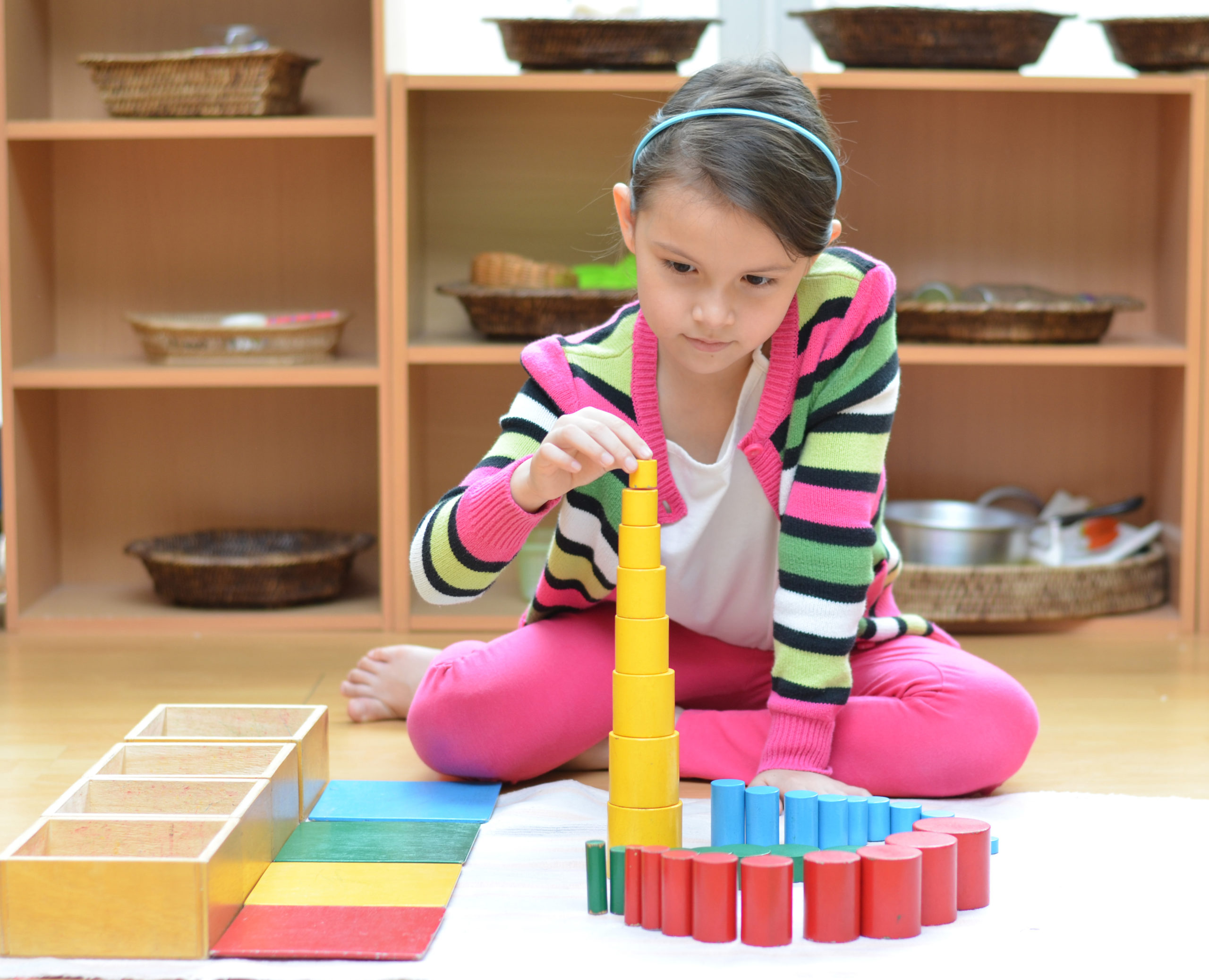
In the Montessori environment, everything is prepared to fulfil the functions associated with the stages of intellectual development: handling the materials, moving about whilst carrying them, and then the manipulations of the materials – pouring from one container to another, opening and closing boxes – with ever-greater dexterity required to carry out these actions.
We have discussed here two essential aspects of a child’s development: their sensory development and their ability to take in their surroundings in a concrete way and then to organise and categorise them. The development of their intelligence depends on the opportunities they are given to refine these senses; we will discuss the sensory materials proposed by Maria Montessori in more detail in a future article.
So, whenever a child feels the urge to touch or handle something, let’s give them that opportunity, in the best possible conditions!