What does ‘prepared environment’ mean in Montessori education?
Why are nursery schools called ‘Casa dei Bambini’ or ‘Maisons des enfants’ in the Montessori method?
Let’s take a step back in time to the days of Maria Montessori, when she began looking after the children of Rome’s San Lorenzo neighbourhood in 1907. She visited one day when the teacher was absent. The children were left on their own in a room with nothing for them to do; their toys were locked away in a cupboard. The tables and chairs were made for adults.
Maria Montessori, astonished, watches these children:
- they are dependent on adults,
- they cannot choose activities in the absence of an adult,
- they have tables and chairs that aren’t suited to their height…
- They are fidgeting, shouting and moving about in a disorderly manner.
Conclusion: the uninformed observer might think that children are naturally unruly and that they need adult authority to settle down and get on with their work.
Maria Montessori sees things differently: she is an anthropologist, remember; her observations lead her to think:
- Let’s offer them furniture that’s the right size for them so that they can move about freely,
- let us offer them freely accessible activities so that they can be independent and free to pursue their own intellectual development,
- Let’s step back, as adults, and see what happens…
The first Casa dei Bambini was born!
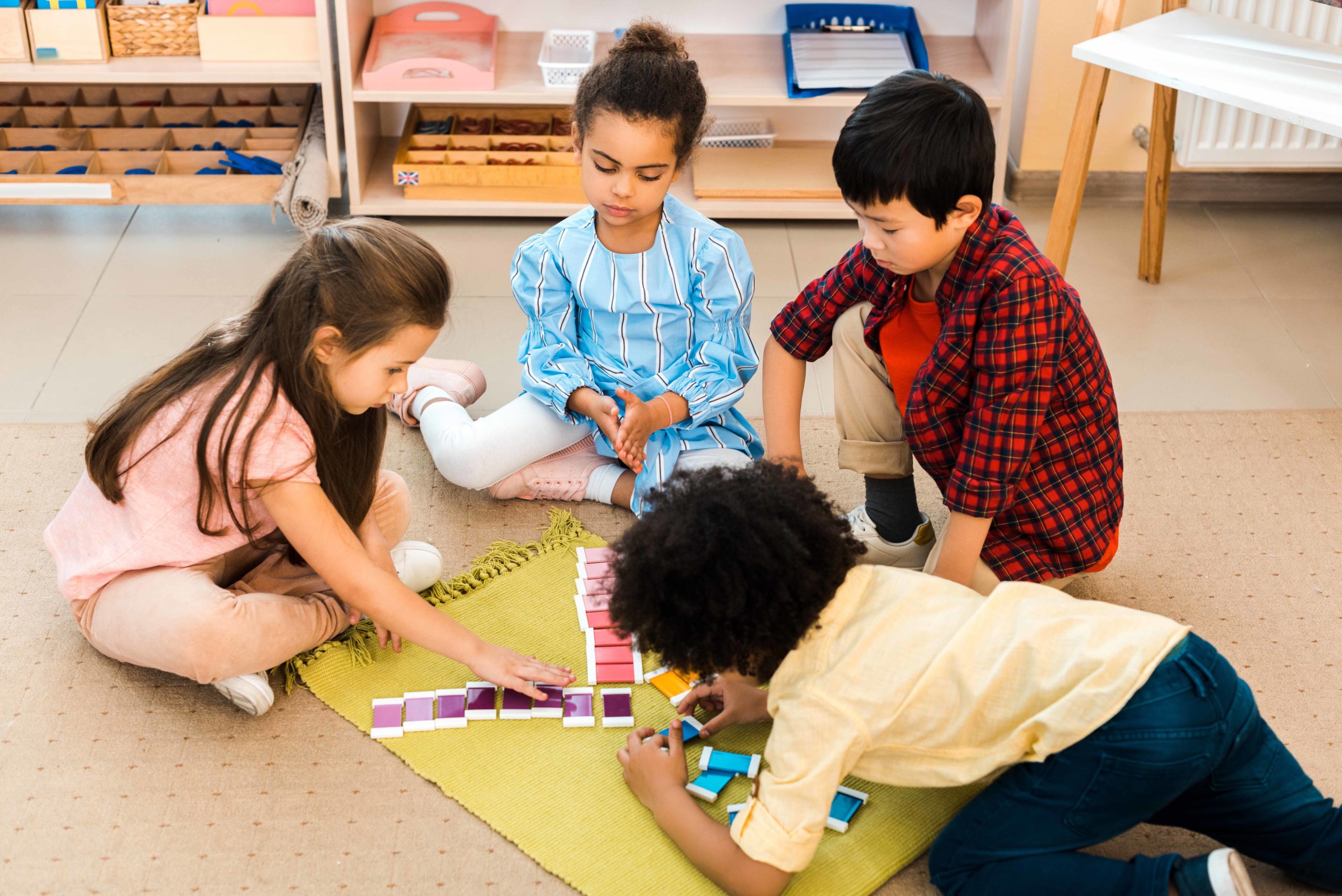
Une classe Montessori est, vous l’aurez compris, un “environnement préparé” pour les besoins de l'enfant.
These needs will change depending on the age group to which the child belongs, and so the class will adapt to meet the needs of each group.
The key criteria that a Montessori class must meet: Montessori:
- Suitable for the age group of the children in care, size of furniture, height of shelves,
- Enabling freedom of movement and choice of activities (the materials are arranged on the shelves within the children’s reach)
- An adult who is observant and discreet and who understands the stages of a child’s physical, emotional, social and intellectual development.
Once these prerequisites have been met, we can see children who are independent, motivated and focused, on the path to self-discipline…